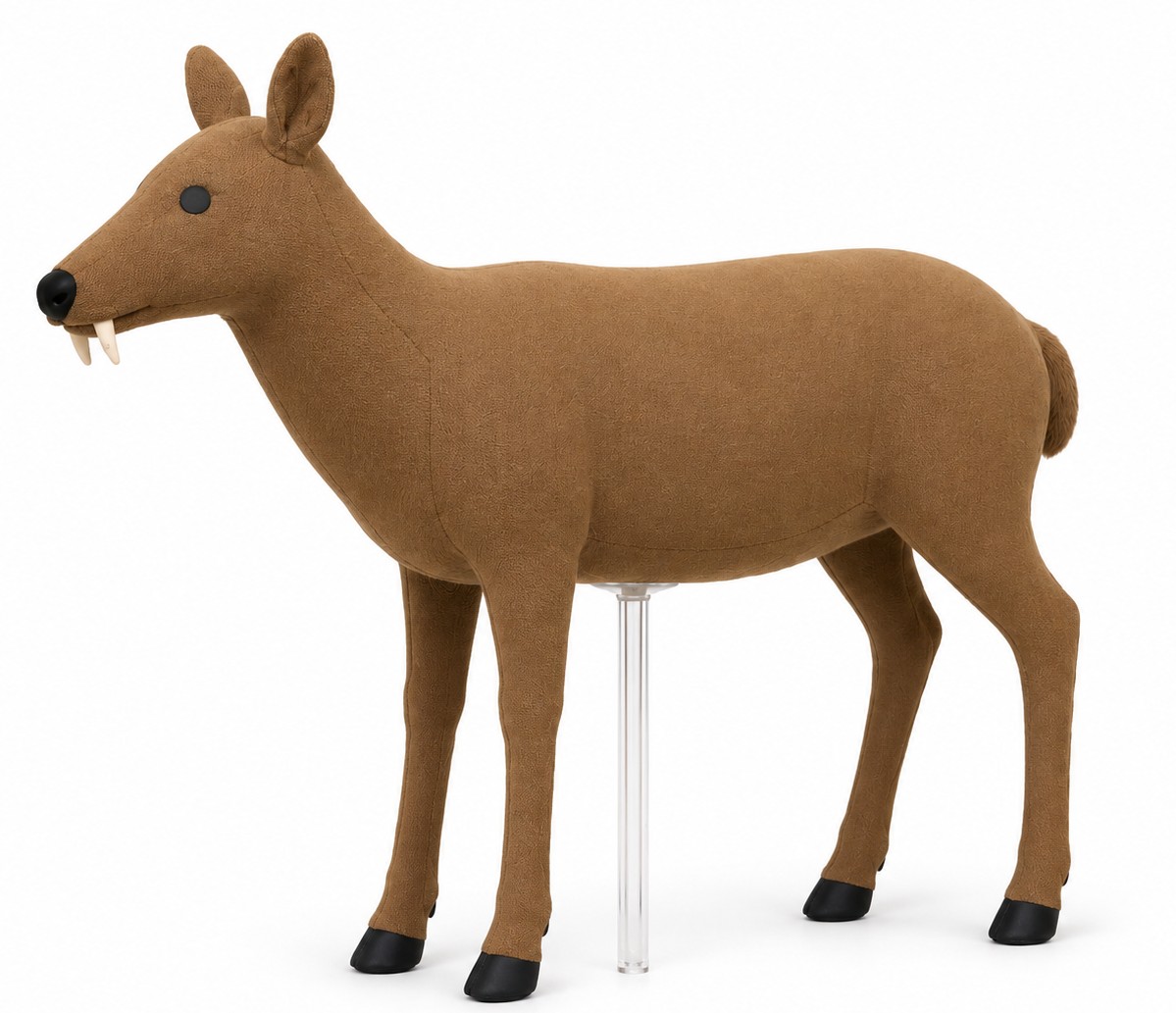
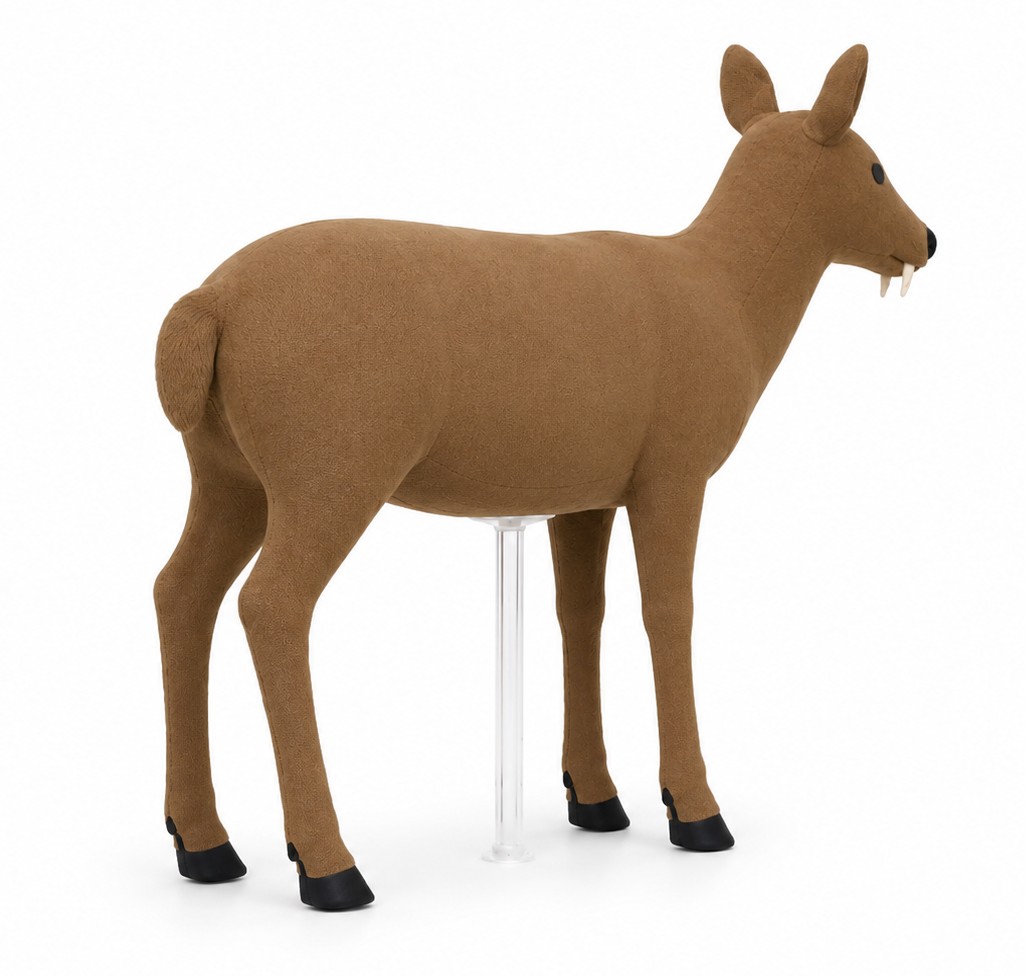
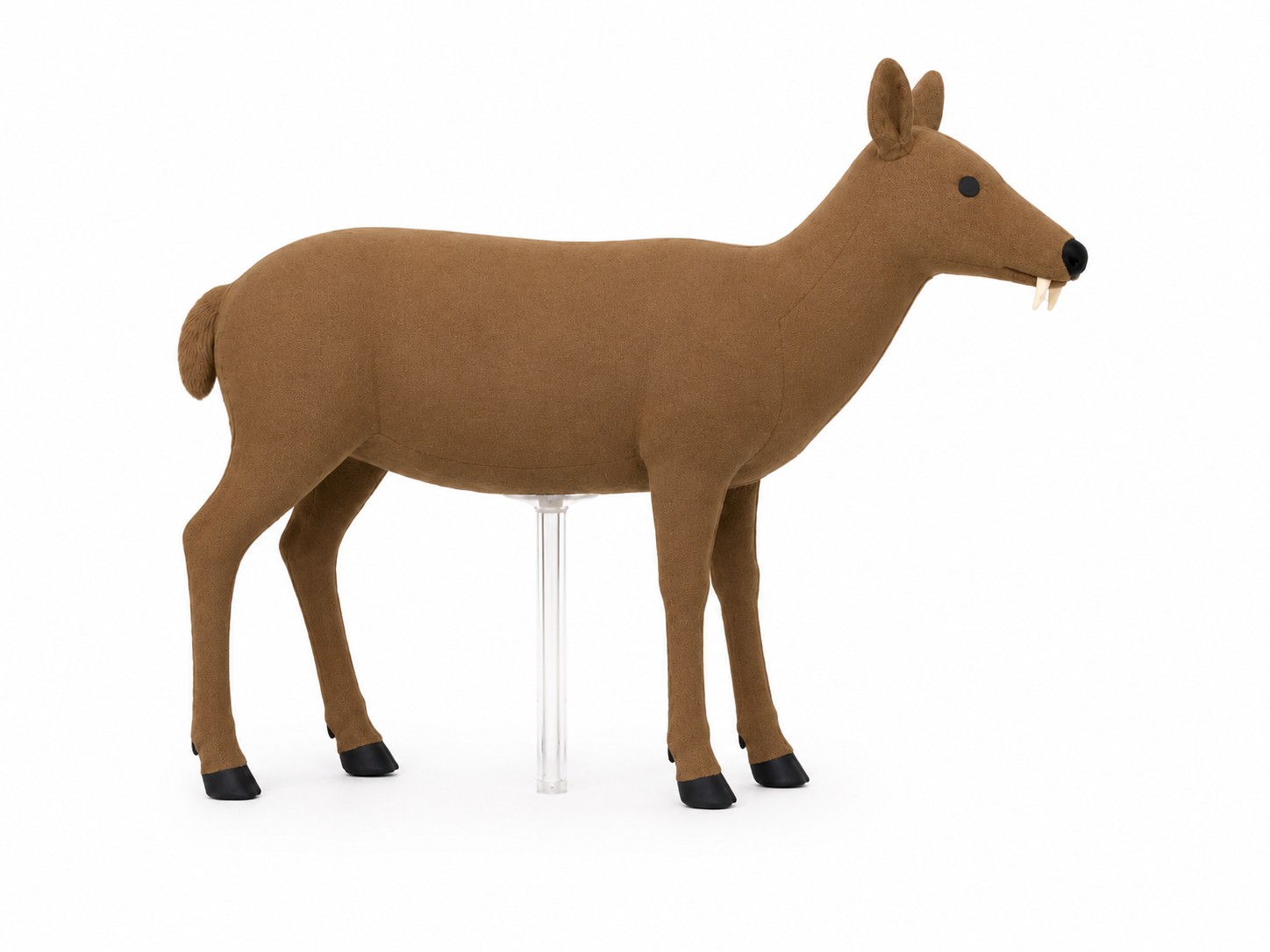

The Water Deer Target is developed for ADAS, intelligent driving and Autonomous Emergency Braking (AEB) testing. It reproduces a representative water deer that may appear, remain stationary or cross a vehicle's driving path in rural, suburban or wildlife-active environments.
The target provides a standardized, repeatable and crash-compatible test object for environment perception, animal detection and classification, collision-risk assessment, trajectory prediction and active braking evaluation.
Designed at approximately 1:1 scale, the target reproduces the representative geometry and appearance of a real water deer, including the head, neck, torso, four legs, ears and tail. Unlike conventional display models, the Water Deer Target is specifically designed for automotive perception testing and can incorporate characteristics suitable for camera, 76–81 GHz millimeter-wave radar and LiDAR systems.
A lightweight, soft and modular crash-compatible construction allows the target to fall, deform or partially separate during impact, reducing the risk of damage to the vehicle under test, onboard sensors and test equipment. Major body components can be rapidly restored or replaced, supporting repetitive development and evaluation testing.
The Water Deer Target can be used as a stationary animal target or integrated with a low-profile robotic carrier, target propulsion platform or towing system to reproduce representative animal scenarios such as lateral crossing, roadside entry, sudden road intrusion, occluded appearance and variable-speed movement.
Technical Specifications
| Item | Specification |
|---|---|
| Product Name | Water Deer Target |
| Target Category | Soft Animal Target |
| Animal Type | Water Deer |
| Scale | Approximately 1:1 |
| Target Posture | Representative natural standing posture |
| Body Structure | Head, neck, torso, four legs, ears and tail |
| Visual Characteristics | Representative body profile, proportions, coloration and local features |
| Camera Compatibility | Suitable for automotive vision detection and classification testing |
| Radar Compatibility | Suitable for 76–81 GHz automotive radar testing |
| LiDAR Compatibility | Suitable for 3D geometry and point-cloud detection |
| Construction | Lightweight, soft and modular |
| Impact Behaviour | Designed to fall, deform or partially separate during impact |
| Recoverability | Rapidly recoverable and reusable |
| Replaceable Components | Head, legs and external body modules |
| Static Testing | Supported |
| Dynamic Testing | Supported |
| Motion Interface | Compatible with robotic target carriers and towing systems |
| Sensor Compatibility | Camera / Radar / LiDAR |
| Typical Functions | AEB, object detection, classification, trajectory prediction and collision-risk assessment |
| Typical Applications | ADAS development, intelligent driving testing, animal AEB testing and sensor validation |
Key Features
1:1 Representative Water Deer Geometry
The target reproduces the characteristic body proportions and geometry of a real water deer, with particular attention to the head, torso, legs and ears that are important for automotive perception systems.
Multi-Sensor Detectability
Designed for automotive camera, 76–81 GHz millimeter-wave radar and LiDAR systems, supporting both individual sensor validation and multi-sensor fusion development.
Soft Crash-Compatible Construction
Lightweight and flexible construction reduces the potential for damage to the vehicle under test during AEB impact scenarios.
Modular and Recoverable Design
Major components can be rapidly restored or replaced following impact, enabling efficient repetitive testing.
Static and Dynamic Animal Scenarios
The target can be used for stationary road-obstruction scenarios or integrated with a motion platform to reproduce animal crossing, roadside entry, sudden intrusion and occluded appearance scenarios.
Typical Applications
Animal AEB testing
Intelligent driving animal detection
Water deer crossing scenarios
Sudden animal intrusion scenarios
Automotive camera detection and classification
76–81 GHz radar detection
LiDAR point-cloud recognition
Multi-sensor fusion development
Collision-risk prediction and trajectory assessment
Vehicle active safety and intelligent driving validation