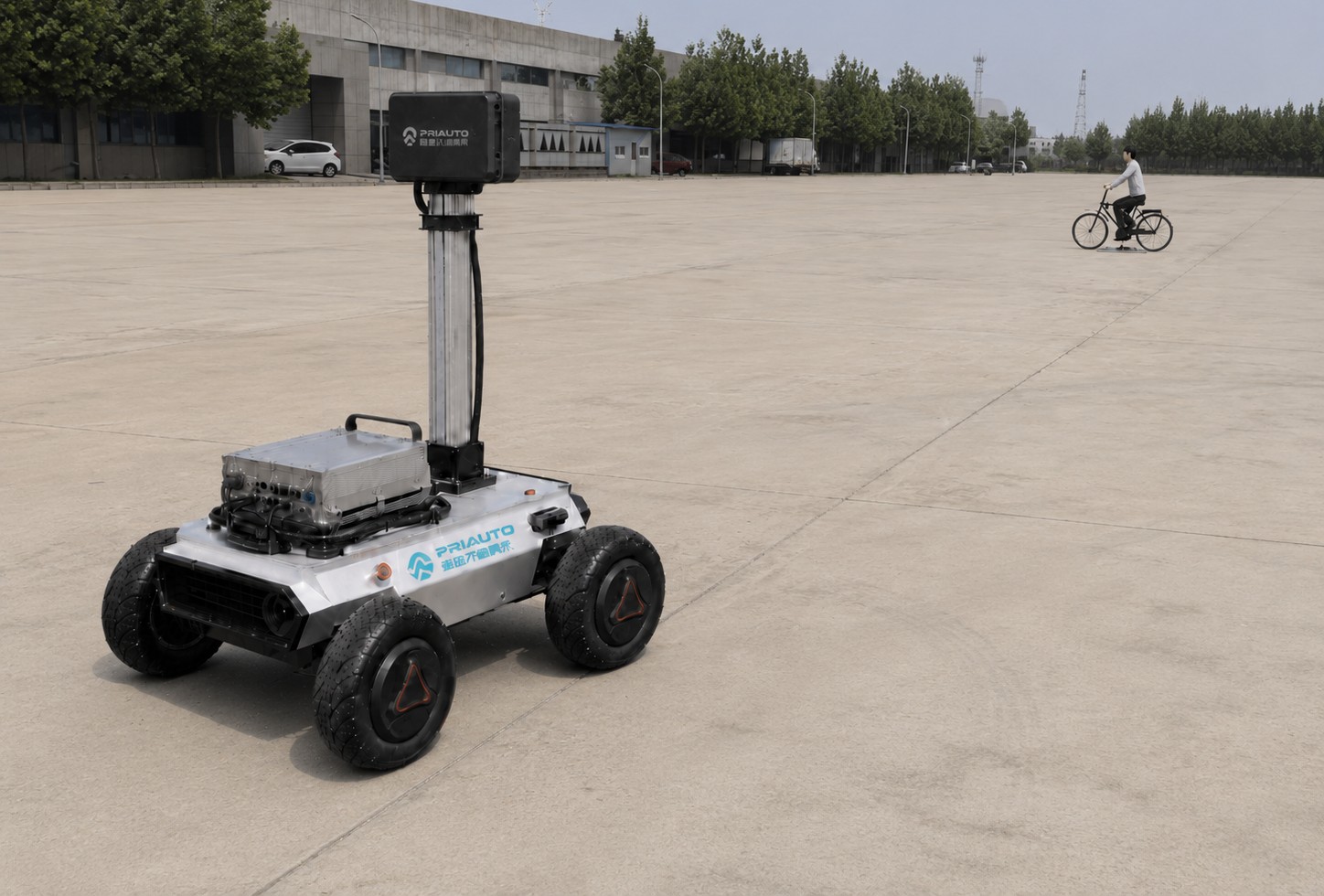

Product Description
The Fixed-Angle Variable-Distance Radar RCS Measurement System is an automated measurement platform designed for radar reflection characterization and RCS-related testing of ADAS test targets. It is used to measure radar echo responses and radar cross-section characteristics under a fixed viewing angle and variable distance configuration.
The system consists of an autonomous mobile chassis, a height-adjustable radar mounting column, an automotive radar module, an industrial computer, and an integrated data acquisition and motion control system. During testing, the radar sensor remains oriented toward the target, while the mobile platform moves along the test direction to different programmed distance points. This enables radar responses to be collected at multiple distances while maintaining a consistent angular relationship between the radar and the target.
The system is suitable for radar reflectivity measurement, RCS-related data acquisition, distance-response characterization, target consistency verification, and metrological calibration support for ADAS test targets.
Configuration
The system includes:
- Autonomous mobile chassis
- Height-adjustable radar mounting column
- Automotive radar module
- Industrial computer
- Integrated data acquisition system
- Motion control system
- Radar data acquisition and analysis software
- Positioning and distance-control module
- Optional calibration reference targets
Key Features
The system adopts a fixed-angle and variable-distance measurement method, enabling radar echo responses to be acquired at multiple programmed distance points while maintaining a stable radar viewing angle.
The autonomous mobile chassis supports programmed linear motion, precise positioning, repeated stop-and-measure operation, and automated distance control, improving measurement repeatability and efficiency.
The height-adjustable radar mounting column allows the radar sensor height to be configured according to different target types and test requirements, supporting pedestrian targets, two-wheeled vehicle targets, vehicle targets and roadside facility targets.
The onboard industrial computer integrates radar data acquisition, chassis motion control, test procedure management, data recording and result output, enabling standardized and repeatable RCS measurement workflows.
The system can support RCS-related measurement and verification of ADAS test targets covered by the ISO 19206 series, especially for test methods involving fixed-angle and variable-distance radar measurements. It can also support the metrological requirements of JJF 2322-2025 Calibration Specification for ADAS Test Pedestrian Targets and JJF 2323-2025 Calibration Specification for ADAS Test Two-Wheeled Vehicle Targets, including radar cross-section measurement and uncertainty evaluation.
Technical Specifications
Measurement configuration: Fixed viewing angle, variable distance
Motion mode: Programmed linear motion
Measurement mode: Stop-and-measure at predefined distance points
Radar mounting:Height-adjustable radar mounting column
Radar type: Automotive radar module
Control system: Integrated data acquisition and motion control system
Computer: Onboard industrial computer
Data output: Radar echo response, distance-response data and RCS-related measurement results
Applicable targets: Pedestrian targets, bicyclist targets, powered two-wheeler targets, passenger vehicle targets, roadside facility targets and other ADAS test surrogates
Applicable standards: Supports RCS verification for ISO 19206 series ADAS test targets
Calibration support:Supports JJF 2322-2025 and JJF 2323-2025 related radar measurement and uncertainty evaluation requirements
Typical Applications
- Radar reflectivity measurement of ADAS test targets
- Fixed-angle variable-distance RCS-related testing
- Distance-response characterization of surrogate targets
- RCS verification of pedestrian and two-wheeled vehicle targets
- Radar response consistency evaluation
- Target development and comparison testing
- Metrological calibration support for ADAS test targets
- Measurement uncertainty evaluation