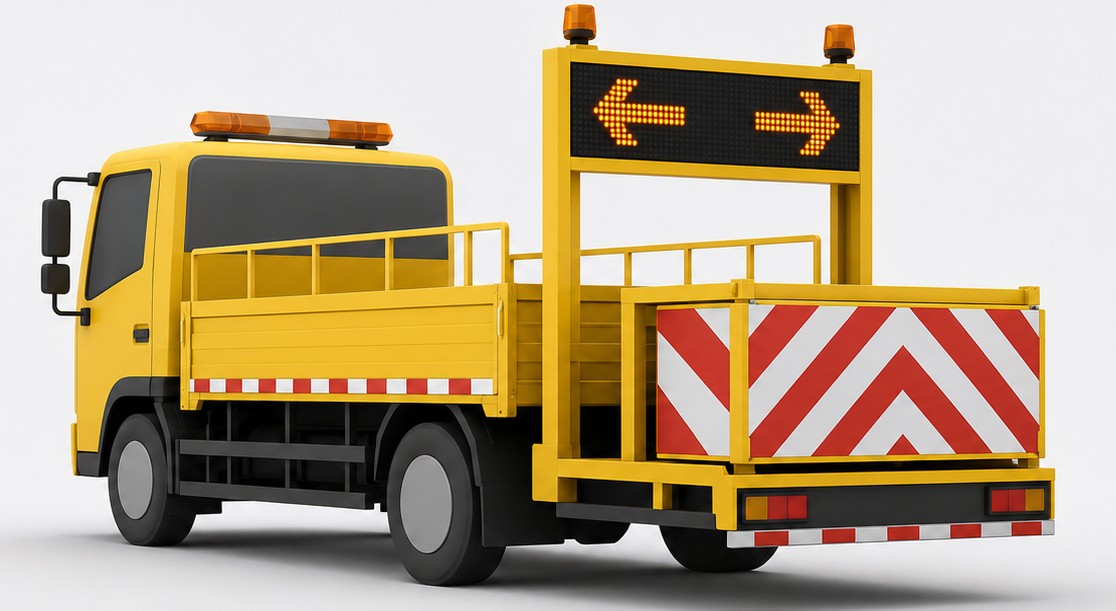



Truck-mounted crash attenuator vehicles are widely used in highway, urban expressway, road maintenance, emergency response, and temporary lane-closure scenarios. They are typically deployed at the rear of work zones, incident areas, mobile maintenance operations, or closed lanes to warn approaching vehicles to slow down or change lanes, while providing impact attenuation in the event of a rear-end collision.
As highway NOA, automatic emergency braking, automatic emergency steering, and lane-level environmental understanding continue to develop, the ability of intelligent driving systems to detect, classify, localize, and respond to crash attenuator vehicles is becoming an important part of ADAS and automated driving safety validation.
The PRIAUTO Truck-Mounted Crash Attenuator Target is developed for ADAS, AEB, NOA, LSS/ELK, work zone perception, and roadside/static object recognition testing. It provides a controllable, repeatable, crashable, and measurable test object for closed-course validation. The target can simulate the key appearance, geometric profile, warning markings, rear crash cushion structure, arrow board, warning lights, and rear visual characteristics of a real truck-mounted crash attenuator vehicle.
Typical Application Scenarios
The PRIAUTO Truck-Mounted Crash Attenuator Target can be used to reproduce typical high-risk scenarios such as highway work zones, temporary lane closures, mobile maintenance operations, incident response areas, ramp diversion zones, and emergency lane occupation.
Test vehicles can approach the target under different speeds, relative distances, overlap ratios, lane marking conditions, lighting conditions, and sensor configurations, enabling systematic evaluation of intelligent driving systems in special vehicle and work zone scenarios.
Typical test scenarios include:
Highway NOA approaching a truck-mounted crash attenuator ahead;
AEB testing with a stationary crash attenuator vehicle in the ego lane;
Work zone tail-end detection and lane-change decision testing;
Obstacle avoidance testing when the target fully or partially occupies the ego lane;
Perception testing under night, backlight, rain, fog, and low-light conditions;
Recognition of arrow boards, reflective markings, warning lights, and red-white chevron panels;
Camera, millimeter-wave radar, LiDAR, and multi-sensor fusion validation;
Automatic emergency steering, lane keeping, and road boundary understanding tests;
AEB false-positive and false-negative boundary condition testing;
Closed-course work zone scenario construction and standardized test protocol research.
Product Features
The PRIAUTO Truck-Mounted Crash Attenuator Target adopts a modular, lightweight, and crashable design. While retaining the key visual features and spatial outline of a real crash attenuator vehicle, it reduces the risk of damaging test vehicles, sensors, bumpers, and proving-ground equipment during high-risk testing.
The target can be configured with different dimensions, rear structures, warning light layouts, reflective markings, arrow board styles, and regional work-zone vehicle appearances according to test requirements.
Key features can include:
Yellow road maintenance vehicle appearance;
Rear red-white chevron crash cushion panel;
High-mounted arrow board;
Top warning beacons;
Vehicle body reflective strips;
Side cargo-bed and vehicle outline;
Rear-mounted crash attenuator structure;
Tail lamps and lower reflective markings;
Representative three-dimensional work vehicle geometry;
Sensor-recognizable features for cameras, millimeter-wave radar, and LiDAR.
Compared with a real crash attenuator truck, the surrogate target is more suitable for repeated high-risk closed-course testing. Real vehicles are heavy and rigid, making them unsuitable for frequent AEB, emergency steering, and offset impact tests. Through a soft, lightweight, and modular structure, the PRIAUTO target helps reduce test risk while improving repeatability and efficiency.
Multi-Sensor Perception Validation
Recognizing a truck-mounted crash attenuator is not simply an image classification task. In real traffic environments, these vehicles often have special body shapes, complex rear structures, high-reflectivity markings, LED arrow boards, yellow maintenance vehicle bodies, and partial occlusion characteristics.
For cameras, millimeter-wave radar, and LiDAR systems, a crash attenuator vehicle is different from an ordinary passenger car, a standard truck, or a conventional roadside static object.
The PRIAUTO Truck-Mounted Crash Attenuator Target can be used to evaluate:
Camera recognition of yellow maintenance vehicles, arrow boards, warning lights, red-white chevron panels, and work-zone vehicle appearance;
Millimeter-wave radar detection of target distance, relative speed, RCS characteristics, and rear structural features;
LiDAR perception of three-dimensional geometry, spatial boundary, rear attenuator structure, and obstacle shape;
Multi-sensor fusion judgment of object type, lane occupation status, risk level, and avoidance strategy.
With this target, OEMs, test laboratories, and algorithm teams can evaluate whether an intelligent driving system can correctly identify the crash attenuator vehicle as a work-zone vehicle or high-risk static object, and whether the system can make appropriate decisions such as deceleration, braking, lane change, or emergency avoidance.
Localized Design for Chinese Road Work Zone Scenarios
In China, truck-mounted crash attenuator vehicles are widely used in highway maintenance, temporary lane closure, emergency response, and mobile road work scenarios. These vehicles usually feature a bright yellow maintenance vehicle body, rear red-white chevron warning panels, high-mounted arrow boards, warning beacons, and reflective markings.
These features are different from many work-zone vehicles used in Europe, North America, Japan, and Southeast Asia. Therefore, localized surrogate target design is important for validating intelligent driving systems under Chinese road conditions.
PRIAUTO can develop crash attenuator vehicle targets based on Chinese road work vehicle characteristics. The target can also be customized for Europe, the United States, Japan, Southeast Asia, and other regions according to local vehicle dimensions, warning patterns, arrow board configurations, and regulatory or evaluation requirements.
This enables the target to serve not only Chinese intelligent driving validation, but also global work-zone perception and automated driving safety testing.
Value for Intelligent Driving Safety Validation
The introduction of a truck-mounted crash attenuator target enables closed-course testing to more realistically reproduce high-risk work zone and mobile maintenance scenarios. For highway NOA and urban NOA systems, crash attenuator vehicles are important objects that must be detected early and handled correctly.
If an intelligent driving system misclassifies the target as an ordinary vehicle, fails to recognize lane occupation, or does not understand the arrow board and work-zone risk, it may create serious safety hazards.
The PRIAUTO Truck-Mounted Crash Attenuator Target can help OEMs, automated driving companies, sensor suppliers, and test institutions to:
Validate work-zone vehicle detection capability;
Evaluate system response to stationary or slow-moving crash attenuator vehicles at highway speeds;
Test the safety boundaries of AEB, AES, NOA, and LSS/ELK systems in work-zone scenarios;
Build work zone, incident response, and temporary lane-closure scenario libraries;
Support the development of China-specific roadside and work-zone surrogate targets;
Promote roadside/static object targets from R&D testing toward standardized validation.