
The Highway Fallen Rock Surrogate Target is developed for ADAS, intelligent driving and vehicle active safety testing. It simulates rocks, boulders and fallen-rock obstacles that may suddenly appear or remain on the driving path of highways, mountain roads, tunnel entrances and exits, roadside slopes and other rockfall-prone areas.
The target provides a standardized, repeatable and crash-compatible test object for environment perception, obstacle detection, collision-risk assessment, Autonomous Emergency Braking (AEB), obstacle avoidance and path-planning evaluation.
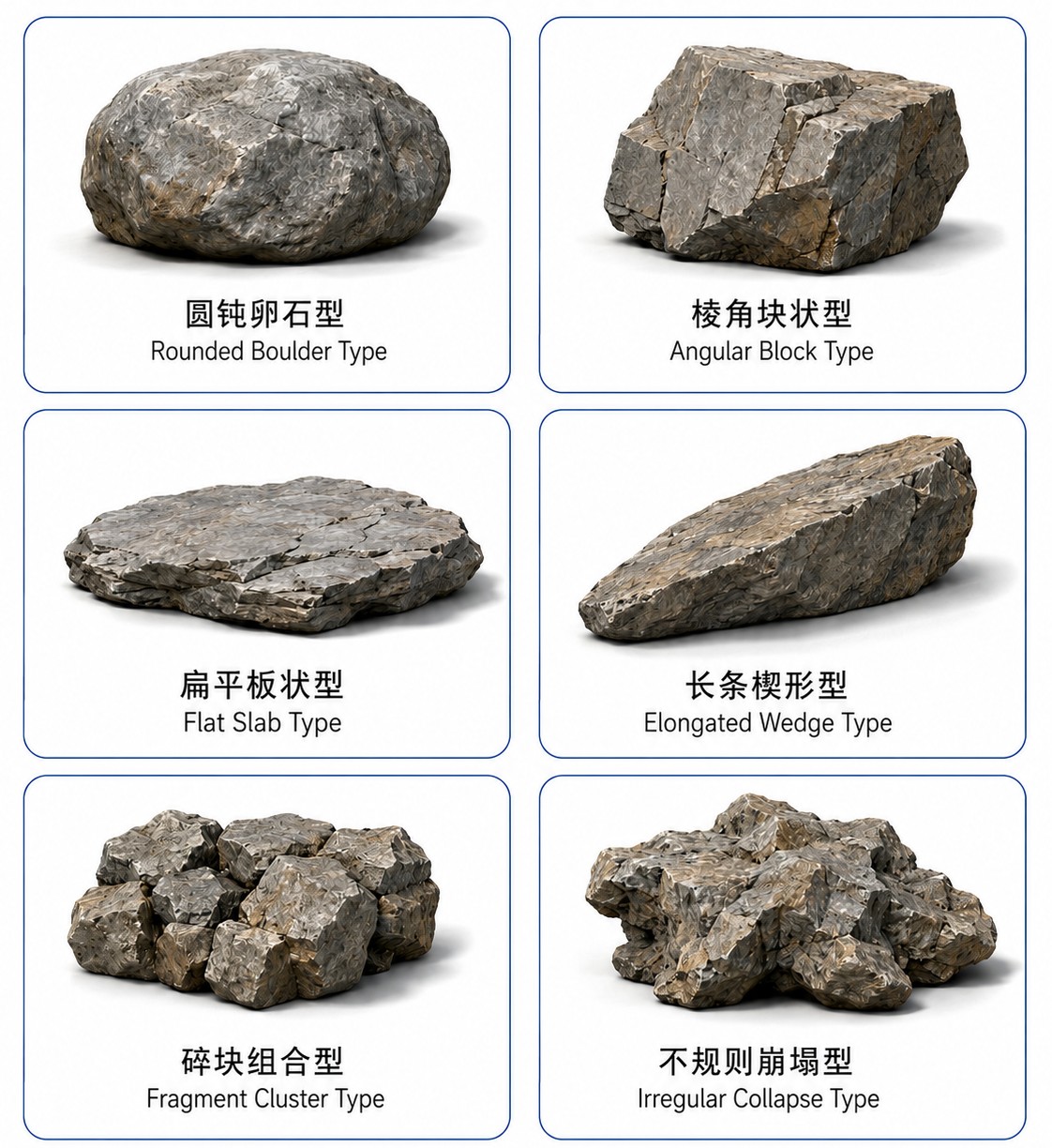
Real-world fallen rocks exhibit significant variations in size, geometry, orientation and spatial distribution. A single regular obstacle cannot adequately represent the wide range of rockfall hazards encountered on real roads. For this reason, the product family includes six representative geometric configurations ranging from individual large boulders to scattered rock clusters and complex collapse formations.
The targets use a lightweight, soft and crash-compatible construction. While reproducing representative rock geometry, surface appearance and three-dimensional profiles, they significantly reduce the risk of damage to the vehicle under test compared with real rocks. Depending on the application, detectable characteristics can be configured for automotive camera, 76–81 GHz millimeter-wave radar and LiDAR systems.
Six Representative Configurations
Rounded Boulder Type
Represents a large rounded boulder shaped by weathering or rolling. It is suitable for single-object rockfall scenarios and large obstacle detection tests.
Angular Block Type
Features pronounced edges and irregular angular surfaces, representing fractured rock blocks created by slope or rock-face failure. It provides challenging visual and LiDAR geometry for perception systems.
Flat Slab Type
A low-profile obstacle with relatively large horizontal dimensions. This configuration is particularly useful for evaluating near-ground object detection by camera, radar and LiDAR systems.
Elongated Wedge Type
Represents an elongated or wedge-shaped rock with a strongly directional profile and is suitable for evaluating the detection and avoidance of irregular long-form obstacles.
Fragment Cluster Type
Consists of multiple individual rock fragments and reproduces a road surface covered by several scattered rocks following a rockfall event. It can be used to evaluate multi-object detection, segmentation, clustering and free-space estimation.
Irregular Collapse Type
Combines multiple rocks of different sizes and orientations to reproduce complex partial slope-collapse or concentrated rockfall scenarios. It provides a highly challenging environment for perception, risk assessment and obstacle-avoidance decision making.
Technical Specifications
| Item | Specification |
|---|---|
| Product Name | Highway Fallen Rock Surrogate Target |
| Target Category | Soft Irregular Road Obstacle Target |
| Representative Configurations | 6 |
| Target Types | Rounded Boulder / Angular Block / Flat Slab / Elongated Wedge / Fragment Cluster / Irregular Collapse |
| Dimensions | Customizable according to representative rock size and test scenario |
| Geometry | Representative rock profiles, edges, proportions and surface appearance |
| Orientation | Supports different road positions and landing orientations |
| Camera Compatibility | Suitable for automotive vision-system testing |
| Radar Compatibility | Configurable for 76–81 GHz automotive radar testing |
| LiDAR Compatibility | Suitable for 3D geometry and point-cloud detection |
| Construction | Lightweight, soft and crash-compatible |
| Impact Safety | Designed to minimize potential damage to the vehicle under test |
| Modular Configuration | Cluster and collapse types can use independently configurable rock modules |
| Static Testing | Supported |
| Dynamic Scenarios | Can support simulated rock-entry or post-fall road intrusion scenarios |
| Sensor Compatibility | Camera / Radar / LiDAR |
| Typical Functions | AEB, obstacle detection, free-space estimation, obstacle avoidance and path planning |
Key Features
Six Representative Rockfall Geometries
Covers rounded, angular, low-profile, elongated, fragmented and complex collapse-type road obstacles.
Low-Profile and Irregular Object Evaluation
Flat Slab and Elongated Wedge configurations provide particularly challenging targets for near-ground and irregular-object detection.
Complex Multi-Object Scenarios
Fragment Cluster and Irregular Collapse configurations reproduce scattered rock debris and partial slope-collapse conditions.
Multi-Sensor Compatibility
Suitable for camera, 76–81 GHz radar and LiDAR testing, including object detection, classification, segmentation and sensor-fusion validation.
Soft Crash-Compatible Construction
Provides a much safer alternative to real rocks for repeated AEB, obstacle-avoidance and intelligent-driving development tests.
Typical Applications
Highway fallen-rock detection
Mountain road rockfall scenarios
Roadside slope-collapse testing
Tunnel entrance and exit obstacle testing
AEB irregular-obstacle evaluation
Automotive camera obstacle recognition
76–81 GHz radar detection
LiDAR point-cloud detection and segmentation
Multi-object detection and clustering
Free-space estimation
Automatic obstacle avoidance
Path-planning validation
ADAS and intelligent-driving development